

Headlines
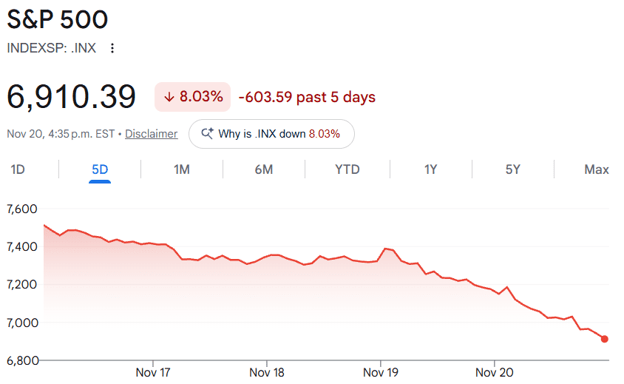
It was quite the week. Chart courtesy Google.
Here are three of Friday’s investment headlines. I’m not surprised and you shouldn’t be either. You knew they were coming.
MarketWatch: “Nasdaq plummets over 3%, wipes out 2026 gains as U.S. stocks head for worst week since ‘liberation day’”
Globe Investor: “TSX heads for biggest weekly fall in over four years, U.S. stocks enter correction territory, as Anthropic fails to rekindle AI optimism”
And CNBC: “S&P 500 and Dow enter correction, Nasdaq wipes out 2026 gain as Anthropic leads AI sell-off”
Let’s dissect these, shall we? And tip of the hat to the headline writers. They’re good at what they do. I pick on them often (see here, here, here, and here), but they want you to read more, and nothing makes you want to read more than a scary headline.
First, though, because it’s important: the cause of what’s happening to investment markets right now is not important to serious and long-term investors. I don’t care about what may have caused what’s happening right now and neither should you. Good investors understand that what’s going on right now is normal.
But if you’re curious, here are some of the causes of previous market drops: trade wars, interest rate hikes, U.S. government shutdowns, global pandemics, a loss of confidence in financial institutions, a Eurozone debt crisis, inflation, tariffs, wars, .com companies run out of basements, and, of course, good old-fashioned animal spirits.
The cause of the drops is important to historians, so leave it to them. Appropriately diversified investors, on the other hand, have to focus on only one thing: how they react.
In almost two decades of doing this, I have yet to see an investor wanting to bail out of their investment plan because their investments have dropped in value. Most investors understand the trade-off between risk and reward. Want the long-term gains? Endure occasional and unpredictable pain.
The variability of the value of investment portfolios won’t make investors act. Instead, it’s the stories they hear that act as the catalyst for those wanting to do something. Sell this, buy that, do what she said, ignore what he said, worship people who sound smart (the pessimists), scoff at the people who sound dumb (the optimists). Buy the dip, run like hell, do this, do that, do something. It’s always a reaction. But remember, good investors don’t react because they already have a plan in place. And they know this is all part of the investment plan.
Now back to the headlines. The first one preys on recency bias: “I could have earned interest from January to now, not have had to deal with a lick of volatility, and I’d still be in the same place! And I wouldn’t have had to deal with what the market was doing way back in April 2025 all over again. What’s the point? I hate investing.”
The second one’s better. “It’s been four years since a week like this? We were due! We were so due. We all should have seen it coming. Isn’t a correction when the market drops 10% from previous highs? Great, my million-dollar portfolio may well have just dropped $100,000. I’m not going to look because that’s more than I’ll make this year. And I thought IPOs were all about excitement. What gives? I hate investing.”
The third one is best, especially if you’re invested entirely in the Nasdaq index (ill-advised, by the way—always diversify!). “Great. That nearly 25% year-to-date return I was enjoying just two months ago is gone. I had $1.25 million just in October. Now it’s back down a million. I hate investing.” (those numbers are illustrative, by the way).
Zoom out, investors. Please, zoom out.
Funds you know you’ll need soon (one to three years, maybe more based on your risk tolerance) should be earmarked in investments that aren’t tied at all to the stock market.
Funds you know you’ll need at some point in the future are invested in things that have had a rough go of late and might continue to have a rough go for a few more months, maybe even years. But you don’t need it anytime soon, and definitely not all at once. It has time to recover.
And what’s happening right now is a normal part of investing. You don’t have to like what’s going on right now. But you shouldn’t be surprised. I’m not.
And things may well get worse from here. Momentum in markets can be vicious. Pardon this loaded question, but what happens after markets stop going down?
That’s what I thought.