

Empathy and Humility
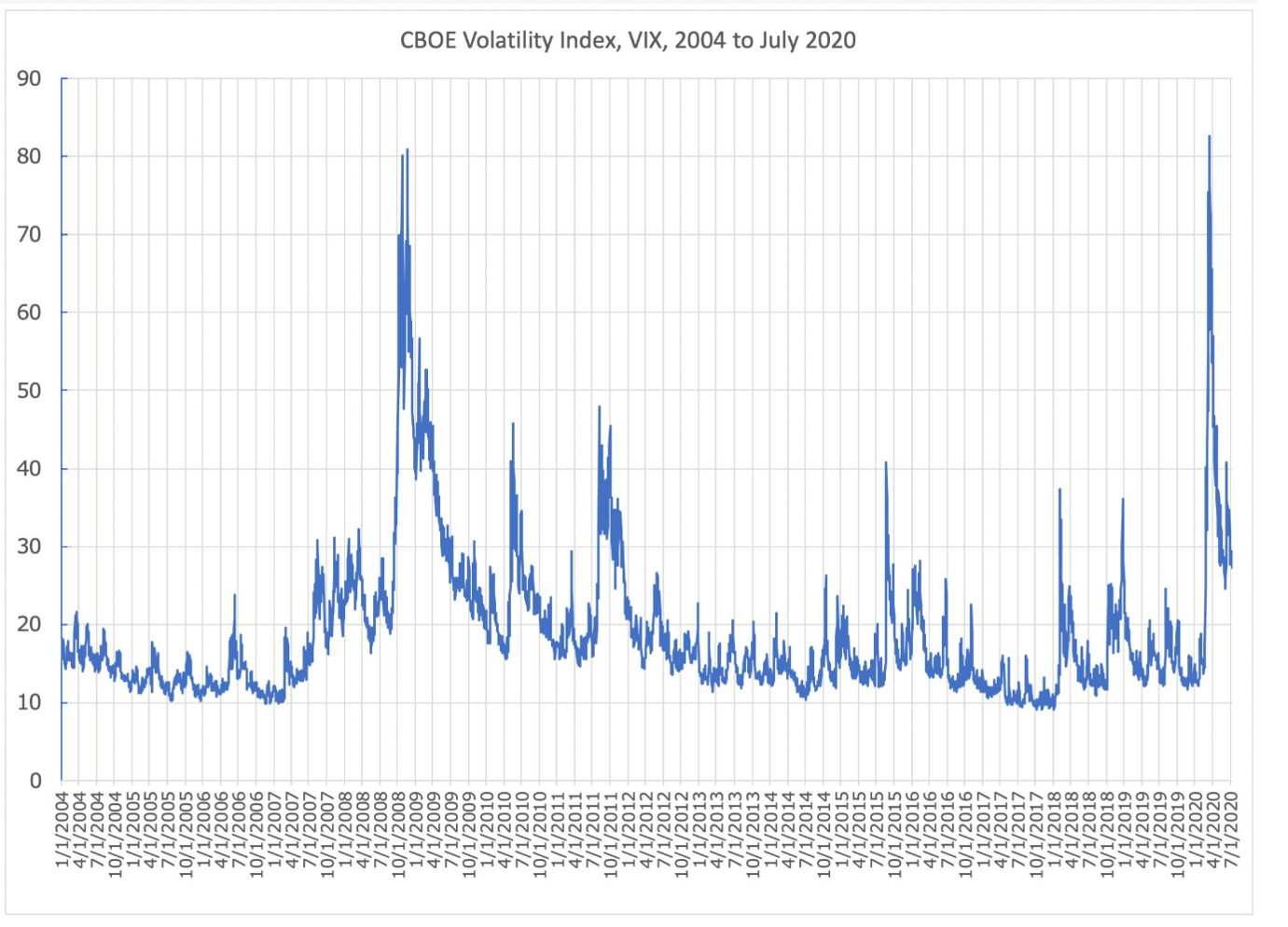
A chart of the VIX (the volatility index), courtesy Wikipedia. Because I couldn’t think of anything less to with empathy and humility.
The total value of the assets we take care of for our clients dropped by about 6% last week. A 6% drop doesn’t sound like a lot because it isn’t. But when you look at it in dollar terms—like I always say not to—it can be painful.
Let’s say we managed half a billion dollars at the start of last week. We don’t right now, but we plan to in the future.[i] On Monday morning, we’d be managing $470 million. That would be $30 million decline in value, but only for the time being.
It took me six years to build my business from zero dollars of assets to $30 million, so my brain can’t help but tell me “the first six years of your business just went up in smoke.” Or say our average client has a million dollars’ worth of investments. Well, my brain is saying that “I just got fired by thirty clients.” And markets may well drop more this week or the week after or into next year too.
I know thinking like this isn’t helping at all because it isn’t accurate, it isn’t fair, and I know my brain is playing tricks on me. I also know that your brain is probably playing tricks on you too.
You need two things to successfully counter what your brain is doing to you right now: empathy and humility. Your life savings going down in value means danger, and danger means fight or flight.
But there’s no lion looking to rip you to shreds. The plane isn’t going down. There aren’t barbarians at the gates. The danger you’re dealing with is between your ears. You can’t fight feelings and you can’t run from them either. Empathy and humility are your best weapons right now. Here’s how to use them.
- You’re not alone
Every single equity investor is going through the same thing you are right now. The world isn’t out to get you and you alone. And no, you didn’t do anything to deserve this. You’re an equity investor. You knew this would happen. You know it will happen again, and again, and again.
This is the price of admission for the long-term returns you’ve earned to this point and can reasonably expect to earn in the future. It’s not for the faint of heart and it’s not meant to be easy. But in my view, it’s the simplest way to get you to where you want to be in the future.
The introduction of this post was a bit longer than usual. I did that on purpose because I have all the same feelings you do. These emotions are normal, and what the market is doing right now is normal too.
Successful investors have to go through you-know-what from time to time. Sometimes these dips are short and sharp, sometimes they’re not. But if you want to be a successful long-term investor, you have to accept these periodic and unexpected drops. The emotions that go along with them are all part of the process.
- No one knows what happens tomorrow
Every time markets go down, people want to know what comes next. The demand for punditry goes through the roof, and so does the supply of pundits. But no one knows what will happen tomorrow. No one. Not a single soul.
If you think charts and commentary from someone ‘who predicted the last bear market’ will tell you what comes next, then at least pair those charts and that commentary with tea leaves, horoscopes, palm readings, and a Ouija board.
It takes humility to know that no one knows what comes next. It’s also a hallmark shared by all successful investors.
- Intelligence won’t save you
We all know people smarter than us, and during times like these we want their advice and guidance. It could be a friend, a parent, a colleague, someone you like listening to on the internet. It doesn’t matter. You’re looking for an intelligent person to help you avoid pain, but their intelligence won’t save you.
I understand the temptation, though. I’m no different. When markets are bad, I read headlines and articles too. But then I remember what Nick Murray said on a Morningstar podcast last year: “I don’t cheer with you when the market’s up, and I don’t mourn with you, much less panic with you, when the market’s down. We continue to work our plan.”
That’s what will save you. Not a headline or a research report, but sticking to your investment plan that almost certainly considered all kinds of market pain.
No matter what intelligent people tell you, accept that their intelligence is of no use right now. You needed intelligence to put together your investment plan in the first place. Now you need grit to see it through.
- Your goals are the same as they were yesterday
See the Nick Murray quote above. Investors should only make changes to their investment plan if their personal situation warrants it. Investors should never make changes to their plans because of investment markets. Doing nothing is an active decision, and it’s also probably the best decision, so don’t change a thing right now.
Your retirement income needs are the same as they were two weeks ago. The money you earmarked for that new car next year is still sitting in a savings account. Your mortgage should hopefully be gone within the next decade.
Your goals haven’t changed, so neither should your investment plan.
- History rhymes but it doesn’t repeat
The S&P 500 index dropped 20.5% on October 19, 1987. That still holds the record for the worst day of all time. It dropped 16.8% in the month of October 2008. That’s still the ninth worst monthly drop on record. And in the year 1931 it dropped 43.8%. That’s the worst year on record.[ii]
What did the market do after October 19th of 1987? What did it do after October of 2008? What has it done since 1931?
Exactly.
I don’t know how long this current downturn will last. Neither do you, and neither does anyone else.
Markets might recover next week. They might fall 20% by year-end. They might go nowhere for the next three years.
But I know what I’ll be doing, and that’s the same thing I was doing last week, last year, and last decade: sticking to my investment plan, taking care of my clients, and reminding myself that a $30 million decline in the value of an investment portfolio doesn’t mean six years of work disappeared or thirty clients fired me.
My brain will tell me otherwise. I know it will. But when it does, I’ll continue to work our plan.
[i] Then a billion after that.
[ii] Data is from the first chapter of Ben Carlson’s book, Risk and Reward (2026).