Exciting and Unsuitable Investments
About once a week I get forwarded a link to a stock, a private investment, or some new thing (usually crypto or AI or real estate). “Have a look at this and let me know what you think. I want to add it to my portfolio.”
Earlier in my career I’d click the link, read the pitch, and then reply with a polite version of “run like hell.” I don’t bother clicking on the link anymore.
People almost always reply with a short “OK. Sounds good. Let’s move on.” I may have just destroyed the utopia they were fantasizing about, the one where that “investment opportunity of a lifetime” turned them into a trillionaire, but they get it: excitement is a bad indicator for the quality of an investment. The more excited you are, the less likely the investment is a good one. Put another way: the more excited you are, the more the investment is a piece of trash.
Sometimes I get pushback, though – and a lot of it. Who am I to crush their dreams? I’m just a wealth manager in Victoria.
And sometimes the pushback hits the point of, “I don’t care. Just buy me the super terrific investment opportunity.” When that happens, and after a lot of disclosures and disclaimers, I’ll put in an unsolicited order for the stock or ETF or mutual fund. If it’s a private investment or something else, I’ll send the funds they need to their bank account and wish them luck. But I take detailed notes explaining the thought process, why the transaction is taking place, and that I don’t think it’s a good idea. I tell them to expect the worst.
I might be wrong. But I figure there are three outcomes:
- The investment is in fact a piece of trash and it goes to zero (but I will never say I told you so).
- The investment isn’t a piece of trash, but it makes no meaningful difference to the future value of their investment accounts.
- The investment goes on a tear. And doubles, triples, quadruples, or even 10xs in a matter of months. If this happens and that growth persists, I’ll get fired. And that’s OK.
I’m writing this because a financial planning website I read put out an article a few weeks ago titled: “The Art of Saying No: How to Handle Client Requests for Unsuitable Investments (And Strengthen Trust in the Process).” It reads like you’d expect: Cover your behind, here’s how to cover your behind, ask questions, and be nice and maintain your professionalism.
I don’t think what they suggest is appropriate. Maybe for someone brand-new in the profession (maybe), but for most what they propose will come off as inauthentic.
“I’d like to buy this dream maker of a stock.”
“What sparked the idea? What outcome are you hoping for? Tell me what caught your attention.”
I can’t imagine replying that way. Wealth advisors get paid to provide people with advice. Not to take orders. We know that the odds aren’t in your favour when it comes to picking stocks, especially speculative ones.
When I wrote about the SpaceX IPO I asked three emotional questions. Here they are again, but this time more generally.
- Do you think buying an investment that everyone wants will result in you reaching your financial goals sooner?
- Do you think if everyone buys it, they’ll all – every last one of them – make life changing sums of money?
- If it’s such an amazing investment, why are they selling it to you?
Then there’s the data.
- Almost 60 percent of US stocks failed to beat Treasury bills (think of a savings account) over their lifetime, almost 40% of stocks just barely returned more than a savings account, and just over 4% of stocks are responsible for most of the market’s returns. That’s from Henrik Bessembinder. Do you think what you’re interested in will be one of that 4%?
- More than half of all stocks never recover and hit their previous highs. That data is from Michael Mauboussin and Ben Carlson. What will you do if it goes on a tear then drops 85% and never recovers?
- Then there’s the SPIVA report. Most professional money managers, with an arsenal of researchers, technology, and fancy computers can’t beat the market long-term. You have none of that, so what makes you think you can stock pick your way into your utopian vision.
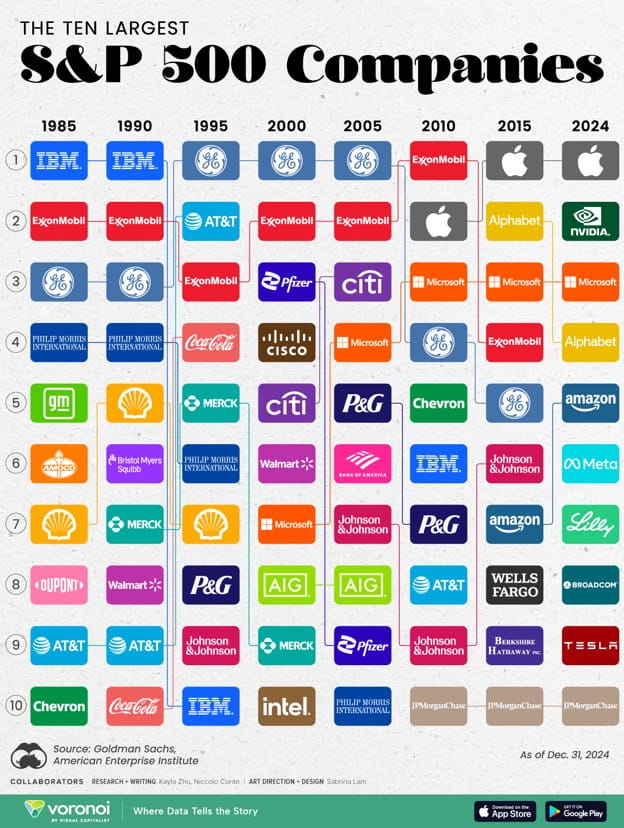
I’ll leave you with this image courtesy Visual Capitalist. Tell me you know which companies will be in the top ten a decade from now, or two, or three. Now tell me you think the investment idea you asked me to “have a look at” will be even bigger than them. Don’t add it to your portfolio, please.