

Momentum
Please see important disclosures and disclaimers below.
Stocks that are going up tend to keep going up. Blame it on fear of missing out, animal spirits, greed, envy, it doesn't matter. Someone just made a ton because of a stock they own? Your brain will demand that you get in on the action while ignoring everything else. But no one knows when that same stock will drop. And it will. We call that pattern the momentum risk factor.
I don’t like the idea of chasing popular stocks. I don’t even like investing in individual stocks. So when people ask me about “getting in” on some stock their friends told them about, I tend to lecture them the way my parents lectured me: “if your friends jumped off a cliff, would you?” They respond as you’d expect: “But, but, but … [insert outlandish prophesying].”
Investment management is a results business. There's always pressure to chase whatever's hot and to show people I know about the most popular stocks. But I will never chase an investment or chase performance. Ever. I believe chasing an exciting investment is like lighting money on fire.
But systematically allocating to stocks showing momentum is different from buying a stock your brother-in-law told you about. The providers of momentum indices and funds all use different methodologies. Some use stock price moving averages, some use trading volumes, and some use their own mysterious 'proprietary models.' What's important, though, is that they're systematic. There's no emotion involved. The data takes care of itself.
And the research and academia support this. Studies on the momentum risk factor go back decades, and the case for momentum investing should hold if done systematically. An investor willing to endure the added volatility of momentum stocks should be compensated with slightly greater returns.
That’s why about five years ago, I added a momentum index fund to the list of investment products we use. It’s not a big component. We purposely keep the allocation small because momentum works both ways. It charges a small fee but we think it’s worth it.
Now, as mentioned below in the small print and italics, this is not investment advice. It’s not even close. This is purely for educational purposes. Don’t make an investment decision based on what I’m writing about. I hate that I have to bombard you with this warning over and over again. And if you’re an investment wonk or an academic reading this, know I’m purposely simplifying things.
Here’s how a global momentum ETF has performed over the last three years net of fees (note: I’m using VMO which trades in Toronto for illustrative purposes only).
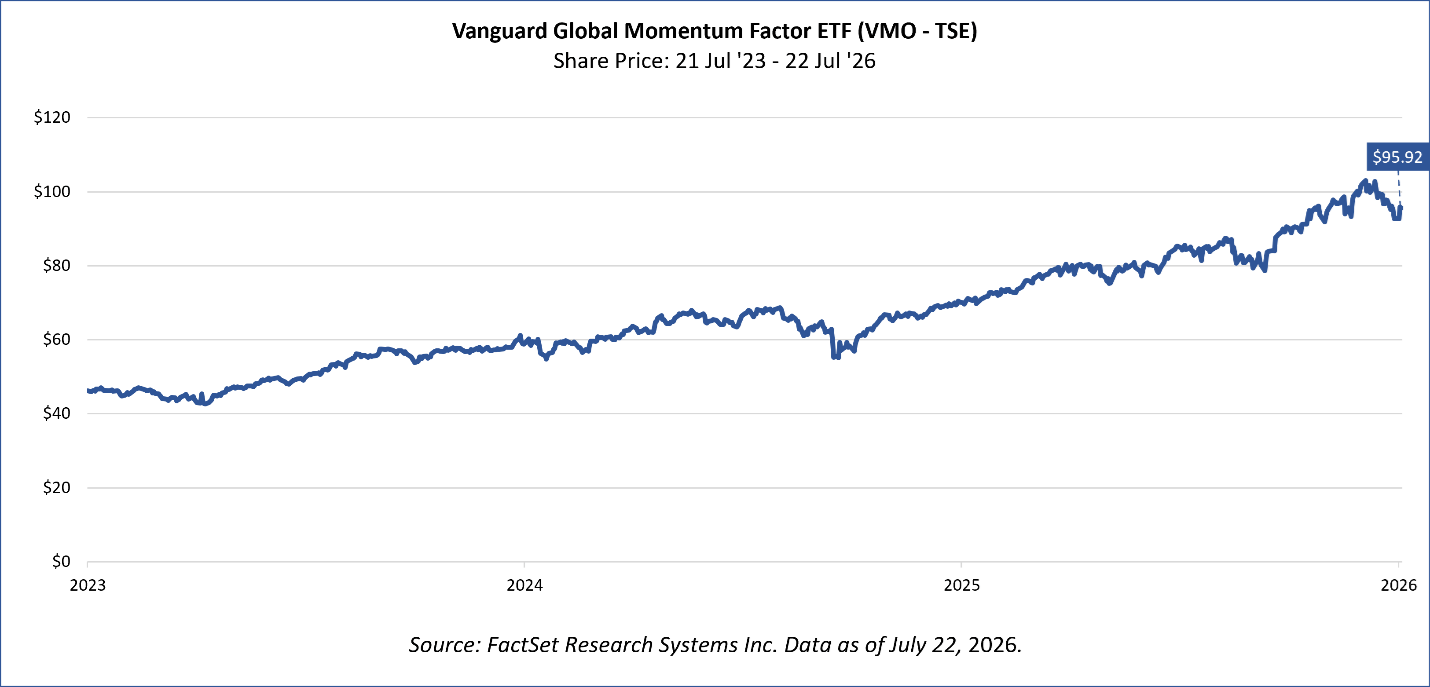
It went from less than $50/unit to almost $96/unit in three years. That is the momentum risk factor at work.
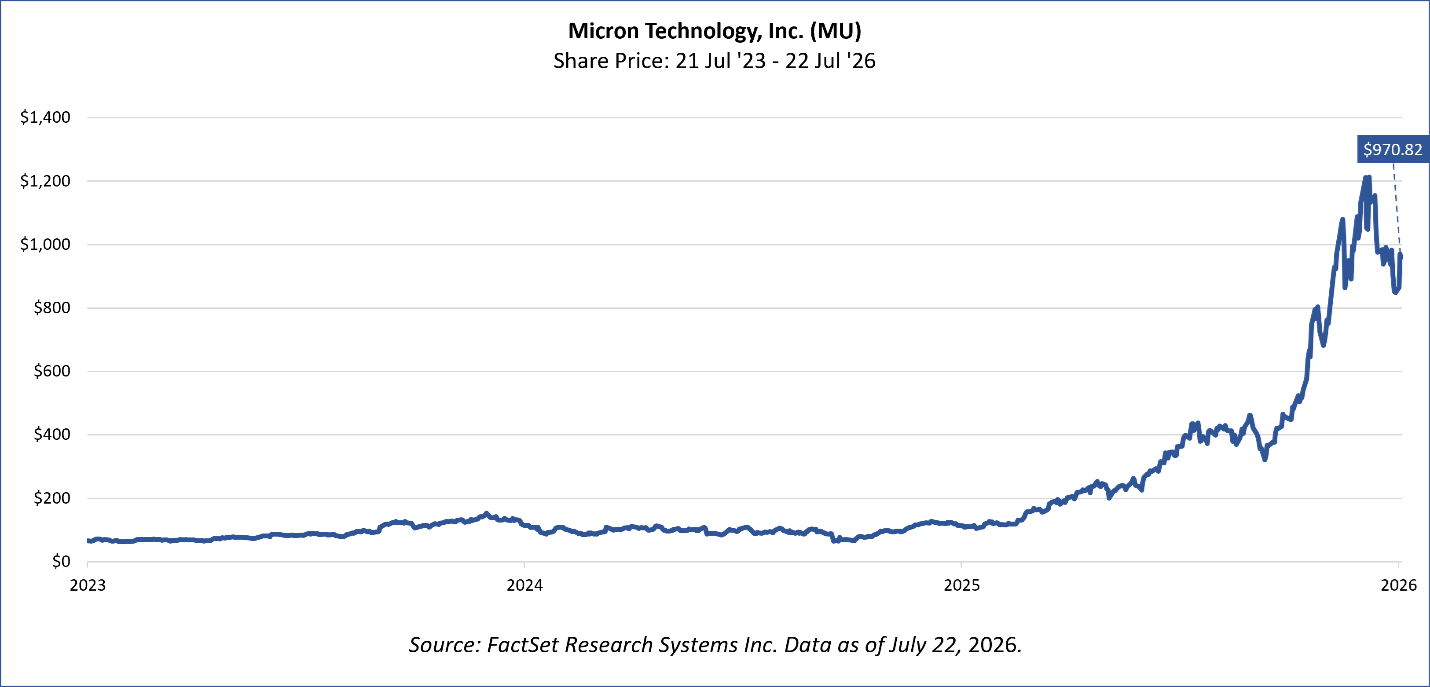
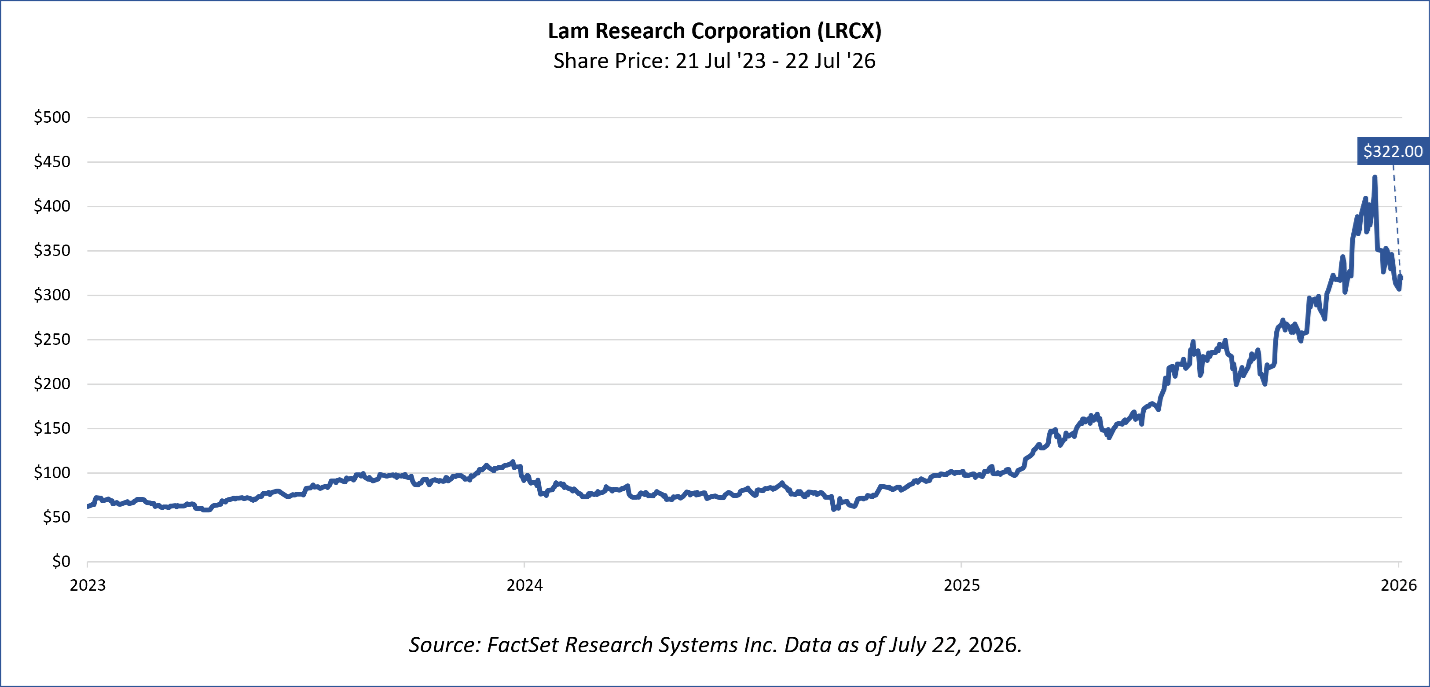
And here’s a look at three of the stocks in the top ten holdings of that index (as of March 31 and June 30 of 2026). Again, these are all also for illustrative purposes only.
Note: I would never, not in a million years, suggest these kinds of stocks to clients or someone reading this because they epitomize the excitable types of investments that destroy wealth. If you’re excited by an investment, it’s not a good investment.
Here’s Micron Technology:
Here’s Lam Research Corporation:
And here’s GE Vernova:
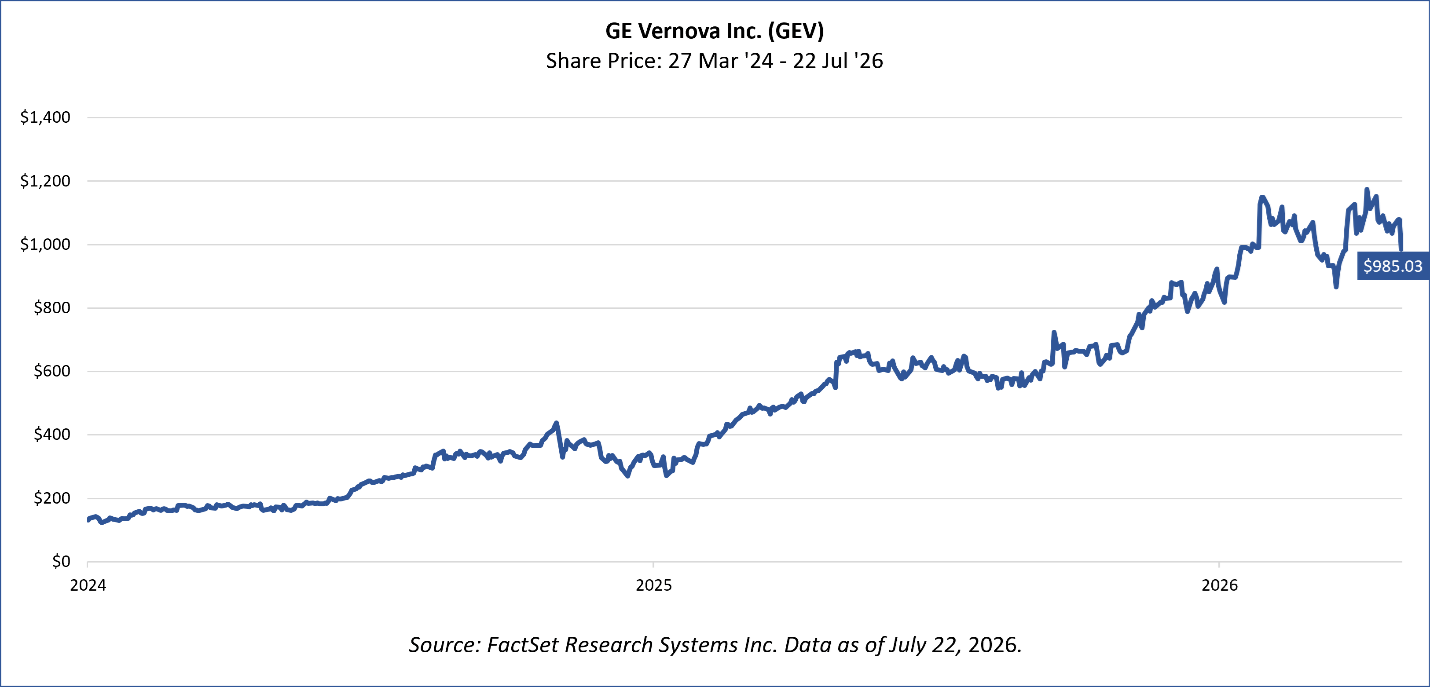
Stocks that are going up tend to keep going up. The three-year performance of those stocks is obscene. I don’t know when they were added to VMO (and I can’t find any reliable data to confirm exact dates), but I’m almost certain they were added long after their stock price momentum initially picked up.
Most people wouldn’t dare buy a stock that just doubled or tripled or quadrupled, nor would a wealth manager suggest it, but fear of missing out is a powerful drug, and that’s because momentum works both ways.
Look at the recent decreases in the share prices of those three stocks. The top right corner of those charts isn’t for the faint of heart. The downside of momentum investing can be vicious.
Micron dropped more than fifteen percent in the first three weeks of July (it’s recovered a bit over the past few days), Lam Research is down close to eighteen percent as I write (the morning of July 23rd), and GE Vernova is down close to twelve.
Combined, those three stocks make up less than three percent of VMO (each individually less than one percent). Diversification is important. Swings like these tend not to be as dramatic at the fund level. They're here as an illustration of how sharp momentum reversals can be.
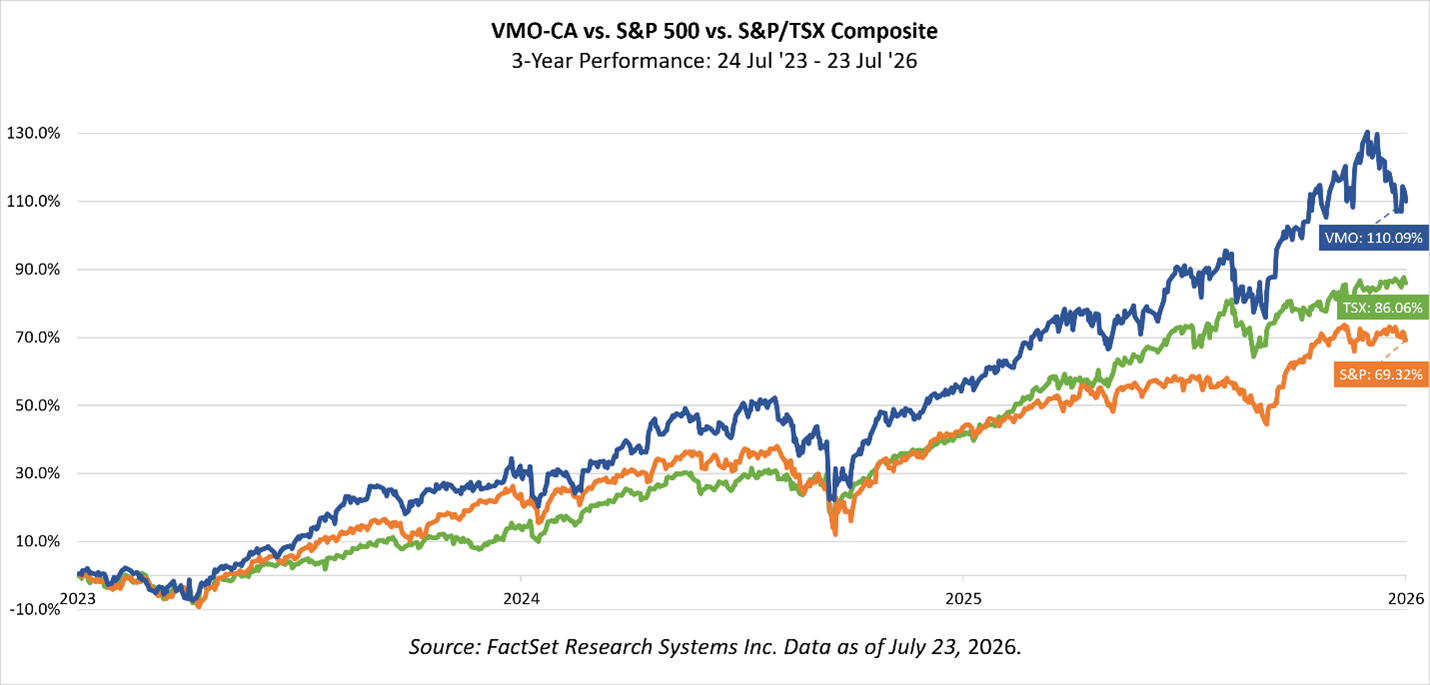
One of the reasons the momentum risk factor has shown to provide returns greater than the broad market is because investors are compensated for that additional volatility. It’s a feature of momentum investing. You have to endure both the good and bad times.
Here’s the three-year chart for VMO (blue), the S&P500 (orange), and the S&P TSX (green).
But here’s the VMO, S&P500, and S&P TSX over the last thirty days.
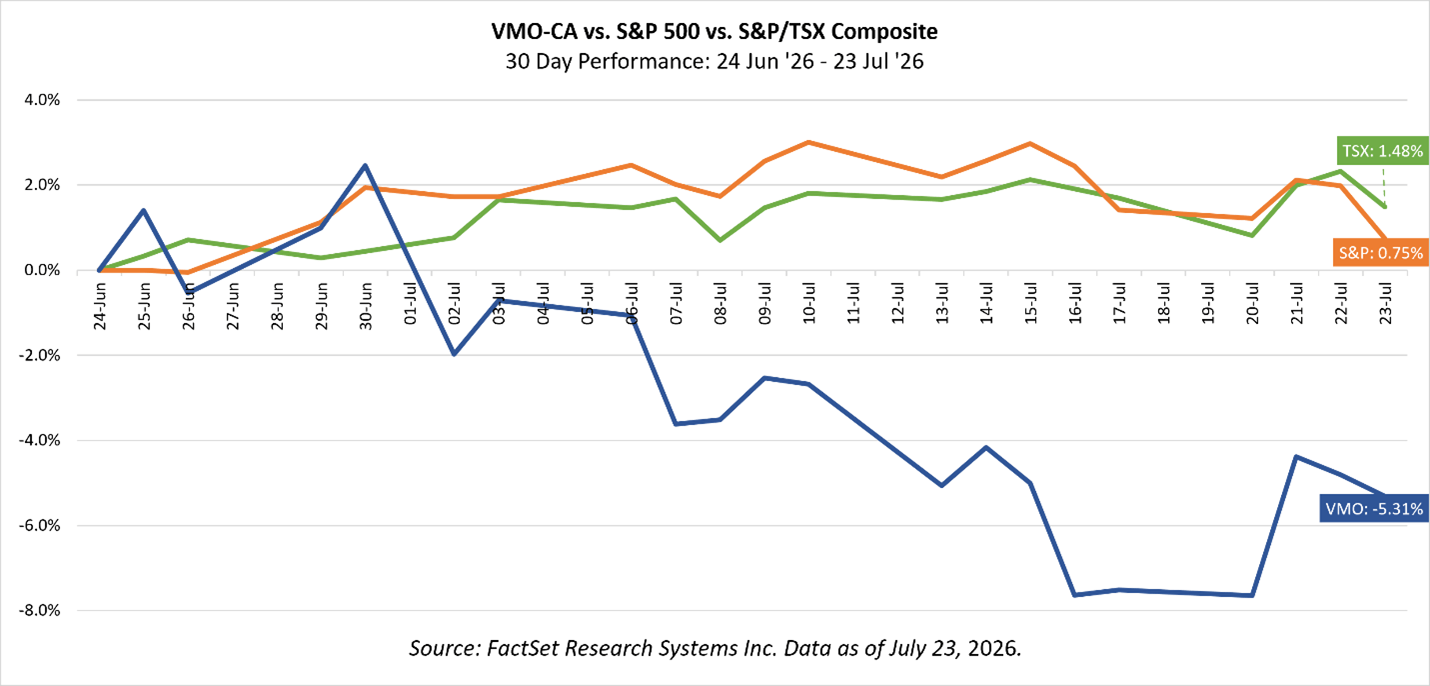
VMO has dropped. And it’s been way more volatility than both the S&P500 and the S&P TSX. But that’s the whole point.
Momentum isn’t the only risk factor. There are others we use with considerable support from the academics. If you’re interested in learning more, Arman wrote a primer on them.
Disclaimers
The information contained in this post (“Post”) is provided by the author in his personal capacity for general educational and informational purposes only and does not constitute, and shall not be construed or relied upon as, investment, financial, tax, legal, or other professional advice of any kind.
Nothing contained in this Post constitutes an offer, solicitation, invitation, or recommendation to purchase, sell, hold, or otherwise transact in any security, fund, index, or investment product, whether specifically named herein or otherwise. Any reference to a specific security, fund, or index is provided solely for illustrative purposes to explain a general investment concept and does not constitute, and should not be interpreted as, a recommendation or endorsement of that security, fund, or index.
This Post does not take into account, and is not tailored to, the investment objectives, financial situation, income, tax status, risk tolerance, time horizon, or particular needs or circumstances of any individual reader. No reader should make any investment decision on the basis of this Post. Readers should consult with a qualified, registered financial advisor prior to making any investment decision.
All statistics, charts, performance data, and other figures referenced or depicted in this Post are believed to be accurate as of the date(s) indicated but have not been independently verified by the author or Raymond James Ltd., and no representation or warranty, express or implied, is made as to their accuracy or completeness. Such information may become outdated or inaccurate without notice and should not be relied upon as current.
Past performance is not indicative, and is no guarantee, of future results. The value of investments, and the income derived from them, can go down as well as up, and investors may not recover the amount originally invested. Any investment involving momentum-related, sector-concentrated, or individual equity exposure may be subject to elevated volatility and risk relative to broadly diversified investments.
Mutual funds, exchange-traded funds, and other investment funds are not guaranteed, their values change frequently, and past performance may not be repeated. Such funds may pay trailing commissions, management fees, and incur other charges and expenses, all of which reduce returns. Investors should read the applicable prospectus, fund facts document, or offering memorandum before investing. Investments in such products are not covered by, and are separate and distinct from, the Canadian Investor Protection Fund.
The views and opinions expressed in this Post are solely those of the author and do not necessarily represent the views of Herlaar Wealth Management or Raymond James Ltd. Raymond James Ltd. is a member of the Canadian Investment Regulatory Organization (CIRO) and the Canadian Investor Protection Fund (CIPF).
This Post is not intended for distribution to, or use by, any person in any jurisdiction where such distribution or use would be contrary to applicable law or regulation.
For additional disclosures, please visit: https://www.herlaarwm.com/vinces-blog