

You Need a Code?
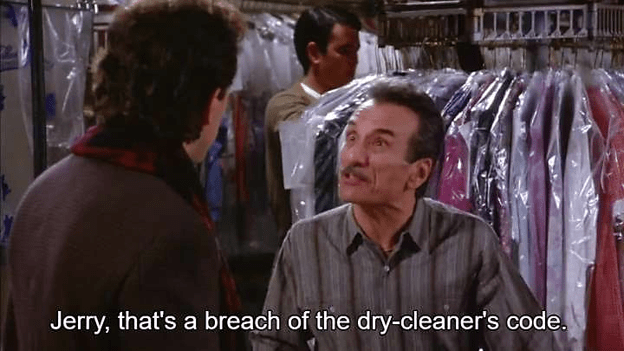
From Seinfeld S6E9 “The Secretary”
Jerry: I saw you the other night stepping out with my Hounds-Tooth jacket.
Willie: Jerry that's a breach of the dry-cleaner’s code.
Jerry: You need a code to tell you not to wear people’s clothes!?
In my current role as a senior wealth manager in Canada, I’m not legally held to a fiduciary standard.* I’m held to something called a suitability standard.
The suitability standard is weak because all that matters about the proposed product or service is that it’s not wrong for you, with minimal consideration given for whether it’s right for you. The suitability standard cares little, if at all, about conflicts of interest, commission-driven suggestions, proprietary products, and undisclosed fees.
The fiduciary standard is strong because all that matters is you. The people or organizations acting on your behalf must put your interests first, both legally and ethically.
There are ways to try to portray yourself as a fiduciary in Canada. I’m a CFA Charterholder, so I must put my clients’ interests above my own and my employer’s. I’m also a CFP Professional, so I have to put my clients’ interests first. And I’m a member of FPAC, so I’ve made my Fiduciary Pledge. And that all sounds good and fine, I’m sure, but the worst that can happen if I don’t abide by the rules is that I get kicked out of the club (FPAC) or lose my letters (CFP and CFA). There’s no legal recourse if I fail to act as a fiduciary.
But people who give financial advice should be legally required to act as fiduciaries for their clients. There should be a fiduciary standard. That it’s not law is obscene. It’s the height of absurdity. But at the same time, it’s embarrassing that we need it at all.
I quoted Seinfeld at the start for a reason: we need a code to not rip people off? Wealth management attracts all sorts of characters, and many of them are bad seeds. Go ahead and google “financial advisor fined or banned Canada” and have a look at the links. And this doesn’t apply only to wealth management. There are bad seeds everywhere. Look out for them and be careful, whether they’re fiduciaries or not.
Earlier this year, I wrote a piece about the questions to ask before working with a wealth manager, and I answered them too. Here are a few more.
- If I don’t want to work with you anymore, how do I get money out?
- If I take my money out, can I do it without triggering taxes?
- Do you get anything from the investment companies we invest with?
- What happens to my money if you get fired, quit, or die?
- If you were a dry-cleaner, would you wear your customers’ clothes?
Acting as a fiduciary because it’s the moral and ethical thing to do is more powerful than acting as a fiduciary because you have to. It should be law. But law or not, be careful.
*I’m held to a fiduciary standard in the US, but if I write about it I have so many more compliance hoops to jump through.