

Pleading for a bear market
See disclaimers below. I use the S&P 500 for illustrative purposes only and because it has the most readily available data.
The hundred-year annualized total return of the S&P 500 is about ten percent.
Since January 1st of 2022 it’s been growing at a rate almost twenty-five percent higher than that hundred-year average (just shy of 12.5%/year annualized). And since the bottom of the Great Financial Crisis – I know that’s an unfair starting point but gimme a break – it’s been growing at a rate just over fifty percent higher (over 15% annualized).[i] At fifteen percent your money doubles every five years or so.
The market is on a tear. Here’s a chart showing the S&P500’s growth in 2023 (blue), 2024 (orange), and 2025 (grey).
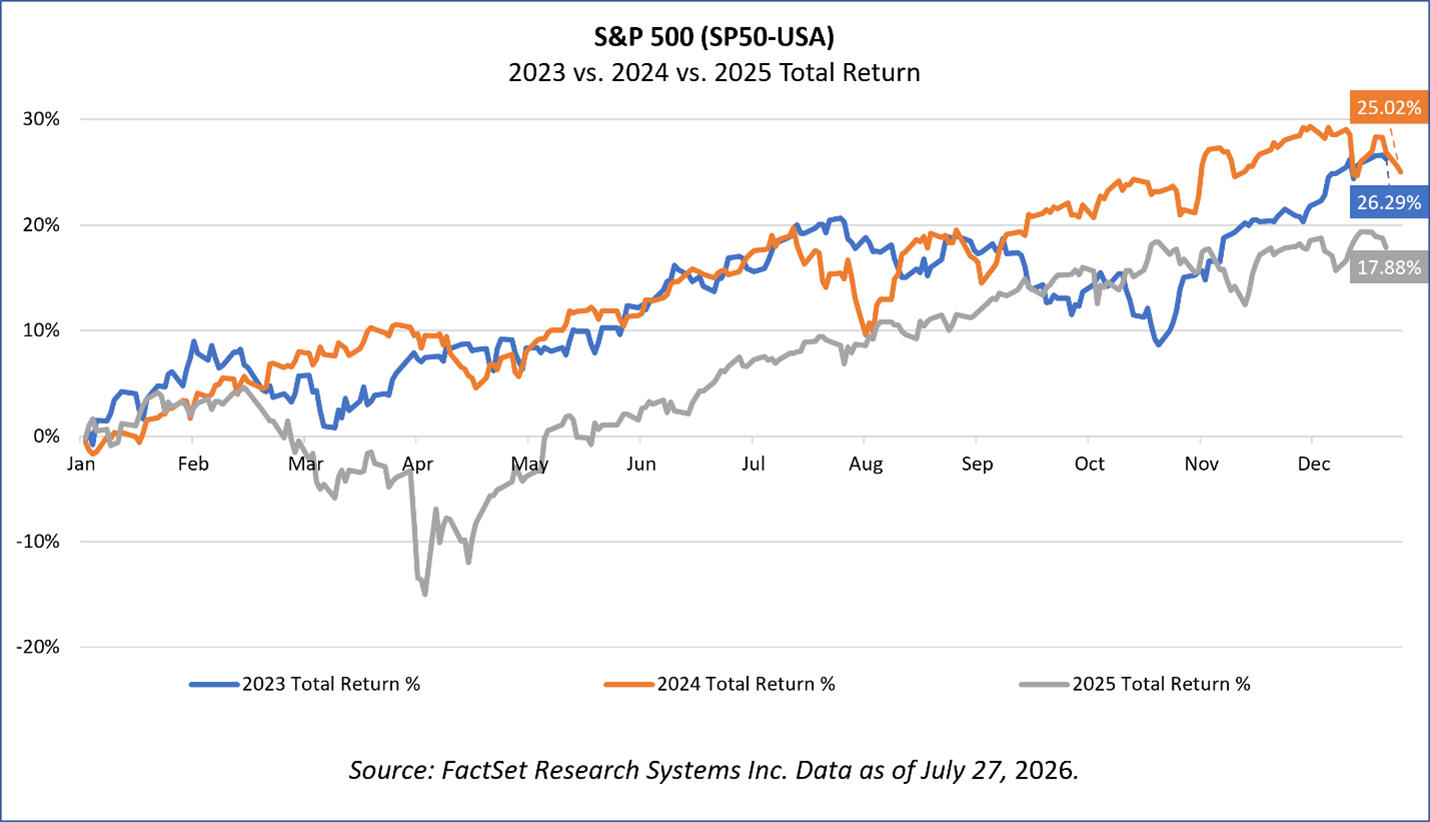
Year-to-date (I’m writing this on July 28th) it’s up almost nine percent.
But here’s how it looked in 2022. If you’re like me, your eyes will be drawn to that low point in October. That was a 25.4% drop from peak to trough in just ten months.
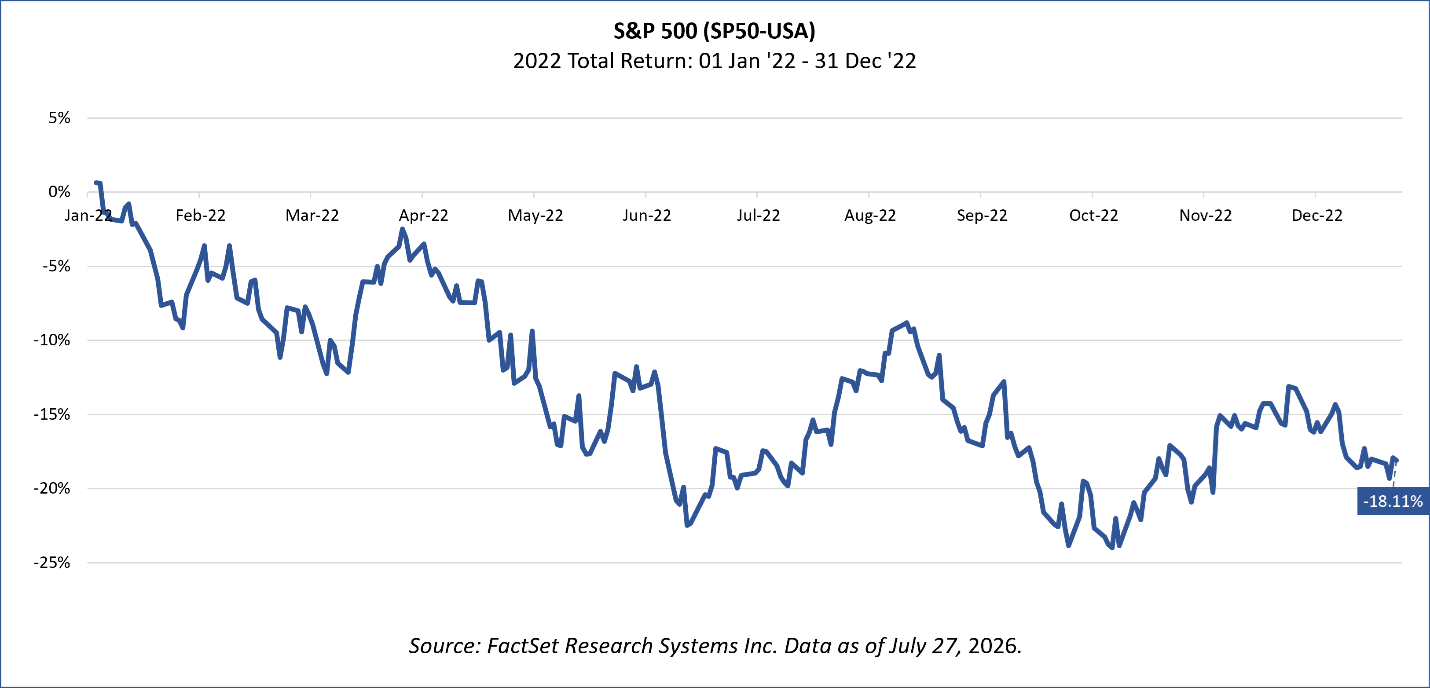
I doubt you remember runaway inflation, oil prices spiking, broken supply chains, interest rates quadrupling, bonds getting hammered, and tech stocks being destroyed. That’s because good markets cause amnesia. Bad ones do too.
Bad markets are part of the process, though. You don't average ten percent a year for free. Your bill comes due. The cost in 2008 was a forty percent drop. It was a ten, then thirteen, then twenty-three percent drop from 2000 through 2002. And in 1973 and 1974 the cost was a back-to-back seventeen and thirty percent drops.
That’s how it’s supposed to work. If you want to earn returns greater than what you’d get in a savings account, you have to endure terrible markets. And what makes terrible markets so terrible is that you don’t get to know when they’re coming.
I like scary movies. They all follow the same recipe. Some directors are much better than others, though: create tension, keep creating tension, make things more intense, but then have the viewer calm down, thinking the scare isn’t actually going to show up. But then it does. Out of nowhere. When you least expect it.[ii]
That’s how bear markets work too. Is it here? Is it here now? Why isn’t it here yet? Oh, would it just show up already?! I give up, the market is immortal. Then, out of nowhere, it finally drops. And there’s no looking back – you never “knew it all along” because if you did you would have done something.
So why aren’t we in a bear market right now? 2026 has provided plenty of the hallmarks of a bear market. Tariffs (always with the freaking tariffs), war in the middle east, oil prices spiking then dropping then spiking again (maybe), the Strait of Hormuz opening and then closing and opening again (maybe), outrageous valuations, investor apathy that only a near four year bull market could provide, and the constant concern that we’re in an AI bubble that’s about to burst (no one knows until it does, if it does).
And about that AI bubble (with thanks to Nick Murray for this data point): from April 2nd to June 5th of this year, a brand new ETF that invests strictly in semiconductor stocks (you know, the nexus of the potential AI bubble) reached $10,000,000,000 of assets. That’s ten billion dollars of assets in just 43 trading days, a new record for ETF growth. Tell me that’s not a bit concerning – it’s epitomizes fear of missing out, one of the worst emotions.
Something’s got to give. But no one – not a single soul – knows what will cause this market to first teeter (is that jump scare coming?) and then eventually drop. If history is any indication the catalyst for the fall won’t be any of the things I mentioned above. It won’t be tariffs or the Strait of Hormuz or AI concerns. It’ll be something else. Risk is what’s left over after you’ve thought of everything.[iii]
My guess? The apathy I mentioned above will be cured by some persistent volatility to the downside. There’s nothing worse (and better) after years of your investments growing and growing and then growing some more than seeing the high values in your account fade away. Oh, you were at a million? Now $950,000? Now $900,000? Hey! That’s a $100,000 drop – I just lost $100,000! The jump scare is around the corner. But when?
Those fears will lead to more fears (they always do) and then we’ll be right back in a bear market. It’s normal. And it’s why I’m pleading for one. Give me something like 2022, please. I hope we don’t see something terrible like the three examples above but I’m ready. Because I’m always ready. It’s the way investing has always worked and it’s how it’ll always work. Want higher returns? You need to be beaten up from time to time. Nobody wins afraid of losing.[iv]
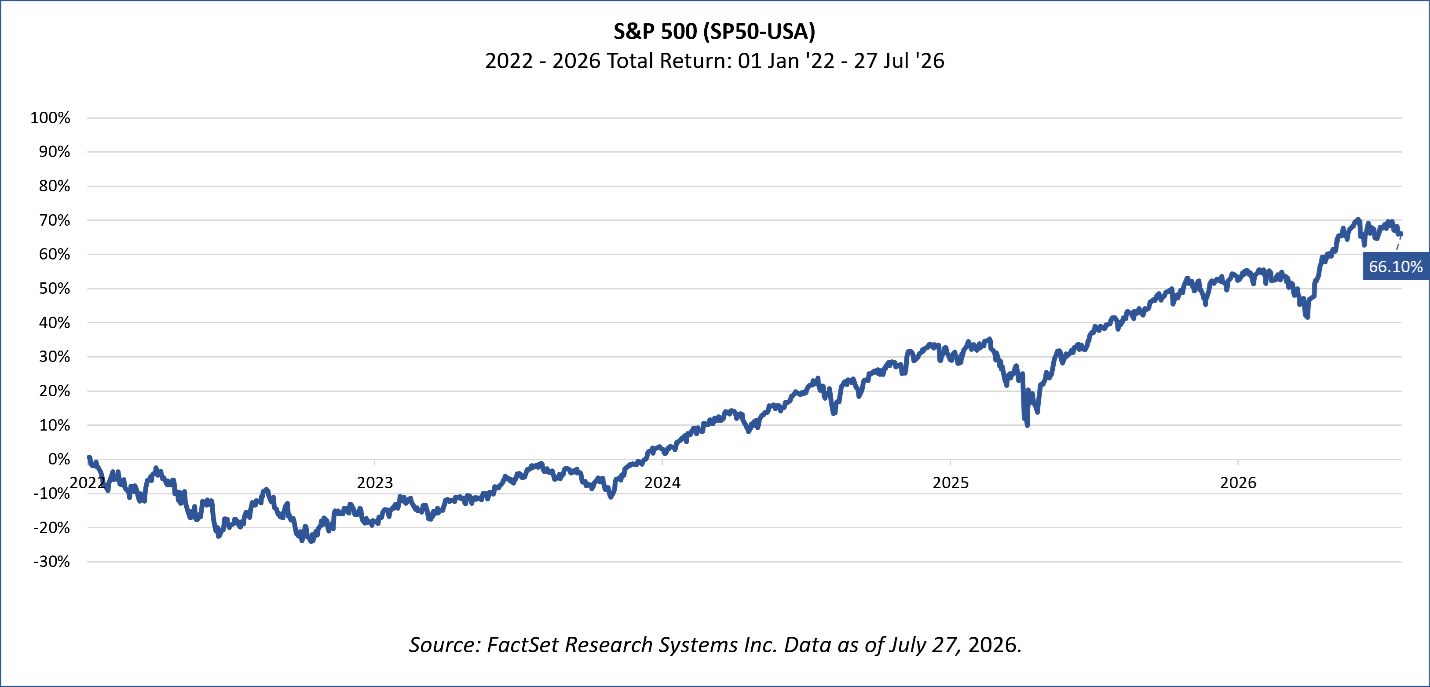
It’s not supposed to be this easy.
*
This post is for educational and illustrative purposes only. Any investments mentioned do not constitute a recommendation or solicitation to buy or sell any security. Past performance is not indicative of future results. Individual suitability varies. What works for one investor may not be appropriate for another. Please speak with your advisor before making any investment decisions. See additional disclosures at https://www.herlaarwm.com/vinces-blog
[i] Data pulled from Nick Maggiuli’s S&P 500 returns calculator.
[ii] If you want two great examples, watch the opening act of Barbarian (fantastic movie) or the house alarm scene in Insidious (terrible movie but that scene is so well done).
[iii] With thanks to Carl Richards.
[iv] With thanks for Chris Stapleton.