

Plan versus planning round II
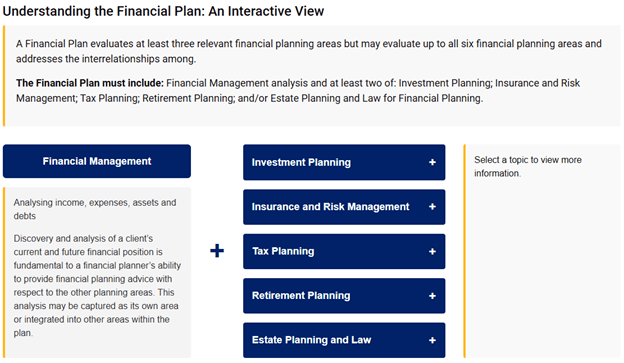
Image courtesy FP Canada’s website.
Ask a room of wealth advisors, portfolio managers, and financial planners if they provide their clients with Financial Plans and every single hand will go up. Some will scoff because no one builds Financial Plans like them. Others will be offended that the question was even asked. And a few will put their hand up because they worry their colleagues will think less of them if they don’t (peer pressure is something, isn’t it?).
I don’t think a lot of people in wealth management provide their clients with Financial Plans. But I think most of them carry out the Financial Planning Process.
Here’s the shortened, but still lengthy, definition of Financial Planning from FP Canada. The bolded words are my emphasis, and I’ll come back to them later.
Financial planning is a disciplined, multi-step process of assessing an individual’s current financial and personal circumstances against their future goals, resulting in the development of strategies and recommendations to achieve those goals while optimizing the allocation of financial resources. The financial planning process can be divided into six distinct financial planning areas, which are:
Financial Management
Investment Planning
Insurance and Risk Management
Retirement Planning
Tax Planning
Estate Planning and Law for Financial Planning
The process of financial planning can be ongoing, involving regular monitoring of an individual’s progress toward meeting their personal goals, values, needs, and priorities, a re-evaluation of financial strategies in place, and recommended revisions where necessary.
And here’s their definition of a Financial Plan.
A Financial Plan is a written document that addresses an individual’s personal goals, values, needs, and priorities. It takes into account relevant financial planning areas, including financial management, and the interrelationships among them.
A Financial Plan includes the client specific information and financial assumptions on which it is based. The client-specific data, assumptions, and projections used by the Certificant when creating the Financial Plan should be clearly documented.
In addition, the assumptions should be discussed with clients to ensure they understand and are comfortable with how they are used in the development of the Plan. A Financial Plan may provide a list of action steps, including what needs to be done, by whom, and when.
A Financial Plan is a product. And ever since robo-advisors showed up more than a decade ago, wealth managers have been told that products are bad because they can either be commoditized or need to be sold. No one likes a salesperson and no one wants to be sold to (but for some reason people are always happy to buy).
Financial Plans can be the reason for starting the Financial Planning Process, and they can sometimes find gaps in an existing and ongoing Financial Planning Process (like discovering an insurance policy with an ex still listed as beneficiary). They can be a hundred pages or a single page. It doesn't matter so long as the product fulfills the definition noted above.
If a wealth manager doesn’t provide their clients with a Financial Plan, it doesn’t mean they’re doing a bad job. The people in the room who raised their hands because of peer pressure can keep their hands down. But only if they’re carrying out the Financial Planning Process.
Financial Planning is a service. It’s imperfect, it’s ongoing, and it’s hard. I bolded the word optimize earlier. Optimizing financial resources is impossible because we are not rational economic humans. It’s what makes financial planning so difficult.
I also bolded the sentence “the process of financial planning can be ongoing.” Can is the wrong word to use. Financial Planning must be ongoing.
That means regular, proactive contact to discuss Financial Management, Investment Planning, Insurance and Risk Management, Retirement Planning, Tax Planning, and Estate Planning and Law for Financial Planning.
Static or one-time Financial Planning is a Financial Plan. A Financial Plan is a product. Products are commoditized and have to be sold. No one wants that.
Further reading: Plans versus Planning. My views have changed a bit in fourteen months. I give all credit to our Senior Financial Planner, Emily, who convinced me (i.e., sold me on the idea) that a fifty-page Financial Plan can add value to the Financial Planning Process.