

Intel Inside
I’m writing about an individual stock today. This is not even close to investment advice. I don’t think individual stocks are appropriate for most investors.
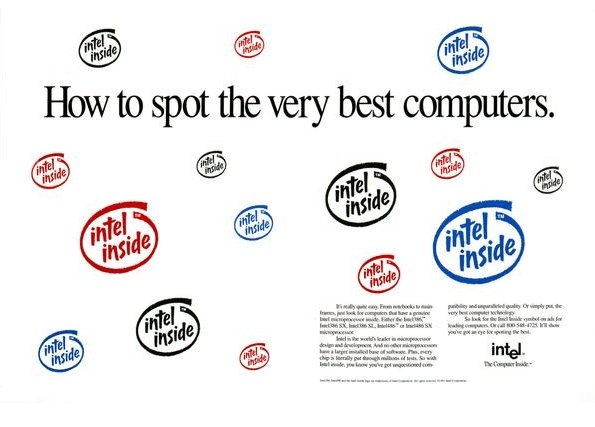
My family was late to the personal computer game. I think I was in grade six when my mom brought home our first computer. She needed it for word processing after volunteering to be the secretary where I played soccer (I think). My dad set it up on a dresser and the keyboard sat on a pulled-out drawer.
I played solitaire and FreeCell every day after school on that machine, but Minesweeper made no sense and it still doesn’t. We didn’t get the internet for another year or two, but my older sister was a typical teenager, spending hours on the phone, so dial-up was useless (and slow).
By the time I was in grade nine two things were clear: if I wanted to play the best video game of all time (StarCraft – and it still is!) with my friends, I needed a more powerful computer and I needed more reliable internet.
The internet problem was solved quickly: Shaw Cable offered the internet via cable instead of telephone, so no more lagging if someone called our landline (my sister had moved out by now). The more powerful computer was a whole other battle.
My brother and I begged our parents for a new computer weekly. They were spending plenty on us because of sports, but after months of whining, they caved.
I knew a bit more about computers than my brother, so my parents and I went to Future Shop. The sales guys (my goodness the salespeople at Future Shop knew what they were doing), kept showing my parents AMD-powered computers.
“Mom, Dad, you don’t understand. AMD is a joke. We’ll be made fun of when people come over and see the AMD logo on our computer. We need Intel! Intel is the best.”
All the Intel-powered computers were more expensive, but as I mentioned, the Future Shop sales guys were good. The more I begged for us to look at Intel computers, the more he showed my parents AMD computers. But then almost out of nowhere, and you know they planned it, one sales guy said to the other, “Tomorrow we’re getting the new Intel PCs. One of them will be priced only a few hundred dollars more than this AMD.”
My parents, like usual, talked about their options in Dutch right in front of the two salesguys. After a quick back and forth, my dad told them we’d be back tomorrow for the Intel machine. My god was I happy.
Now here’s Intel’ stock today.
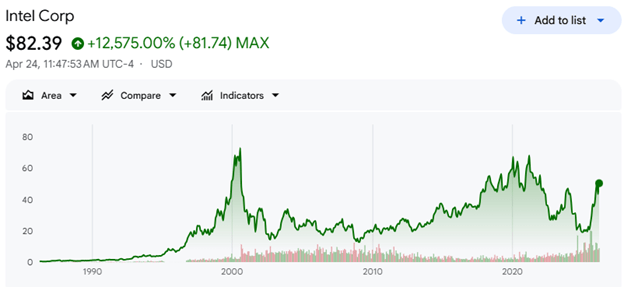
The Tech Boom still ruins long-term performance charts for companies like Intel. Imagine being the person who bought Intel at the peak. They’re still underwater, and without Intel’s recent jump in price, they’re near the ocean floor.
Intel was once the crown jewel of tech companies. Their marketing was exceptional and their product was quality. Just look at how well they secured me and my family.
Then they made their own problems. They launched a product called Itanium with Hewlett-Packard in 2001. Itanium was meant to give Intel dominance in the server market, but the product was a disaster. AMD – the same AMD I wanted to avoid – swooped in, wiping Intel out of that market.
Six years later they passed on the opportunity to be the chipmaker for the iPhone. They were still providing chips for Apple computers and laptops. But they passed on the iPhone. Hindsight is vicious.
The next fifteen years were ugly. They paid AMD (them again!) $1.25 billion to settle antitrust claims. Manufacturing improvements were repeatedly delayed. Many acquisitions proved terrible. A CEO abruptly called it quits, and the new one was an accountant with no engineering or semiconductor experience.
Then, in 2020, Apple dumped them entirely. Apple’s Silicon chips made Intel’s processors look like something from the Stone Age.
When ChatGPT launched in 2022 and AI became the product du jour, Intel was nowhere. Today, Nvidia’s data centre revenue dwarfs Intel’s.
Investing in individual stocks is hard. You can look at balance sheets, income and cash flow statements, and analyze the data to see if a company is a good investment. You can look at charts and try to buy companies you think are “oversold.” You can look at sectors and markets and narratives and pick the companies you think will beat out the competition. Or you can do all those things and still not have a clue.
Intel was THE tech company. But over a quarter of a decade later, it was a joke, especially when compared to most of its competitors.
And today? Well, look at this:
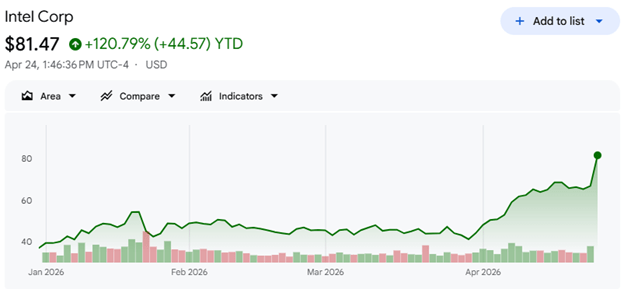
Here’s Intel’s year-to-date performance. Had you bought Intel stock on New Year’s Day, your investment would have more than doubled. But all that growth would have taken place in the last month or so.
That kind of growth always scares me. The headlines suggest it’s because of the AI boom and a strong quarter. But nobody knows right now. It could well just be caught up in AI fever.
Will it keep going up or will it come crashing down? Have they finally figured out how to profitably take part in the AI industry? Or will the way they’ve done things for the last twenty-five years outweigh any progress?
I don’t know. Neither do you.
I hate stock picking.
Endnotes.
The image is courtesy computerhistory.org ("Intel Inside" advertisement)
The charts are courtesy Google (since inception price chart of INTC and YTD price chart of INTC)